
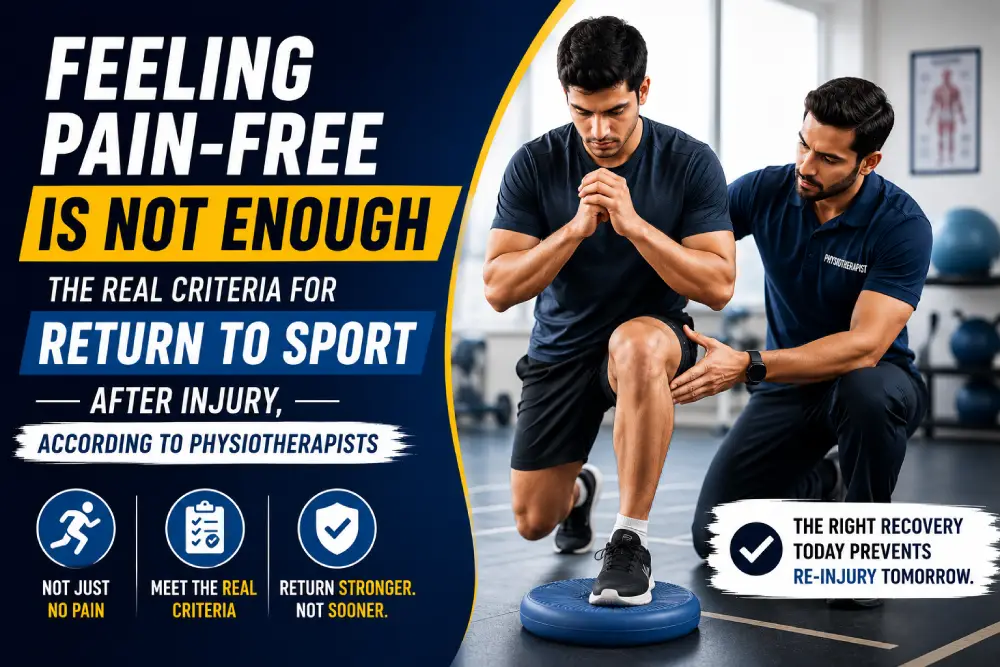
One of the most common mistakes athletes and active individuals make after an injury is assuming that “no pain” means “fully recovered.”
The discomfort reduces, swelling disappears, movement feels easier, and confidence slowly returns. Naturally, many people feel ready to jump back into training, running, football, gym workouts, or competitive sports immediately.
But this is exactly where many re-injuries happen.
According to sports rehabilitation experts, pain reduction alone is not a reliable indicator of full recovery. In many cases, the body may still have weakness, poor stability, reduced balance, or movement dysfunction even when pain is no longer present.
This is why physiotherapists do not use pain alone to decide whether someone is ready to return to sport.
They look much deeper.
Why Feeling Better Can Be Misleading
Pain is only one signal from the body.
After injuries involving:
- ACL tears
- Ankle sprains
- Hamstring strains
- Shoulder injuries
- Muscle tears
- Knee pain
The body often adapts in ways people do not immediately notice.
For example:
- One side may still be weaker
- Movement patterns may change subconsciously
- Balance and coordination may be reduced
- Joint stability may not fully recover
An athlete may feel “normal” while walking but still struggle with explosive movements, sudden direction changes, jumping, sprinting, or landing mechanics.
According to the British Journal of Sports Medicine, returning to sport too early significantly increases the risk of re-injury, especially after lower limb injuries. This is why rehabilitation focuses on function, not just pain relief.
What Physiotherapists Actually Assess Before Return to Sport
Returning to sports safely requires more than just waiting for symptoms to disappear.
Physiotherapists usually evaluate multiple recovery markers before clearing someone for higher activity levels.
1. Strength Recovery
This is one of the biggest factors.
After injury, muscles around the affected area often become weaker due to:
- Reduced movement
- Swelling
- Pain inhibition
- Lack of training
For example, after ACL surgery or knee injuries, quadriceps weakness can continue even when the athlete feels pain-free.
If strength is not restored properly:
- Joint stress increases
- Stability reduces
- Injury risk rises during sports movement
This is why rehabilitation programs focus heavily on progressive strengthening before return to play.
2. Balance and Stability
Sports require constant control of body position.
Even small reductions in balance can affect:
- Landing mechanics
- Direction changes
- Running efficiency
- Joint control
Research in sports medicine shows that poor neuromuscular control is strongly associated with recurring sports injuries.
This is why physiotherapists include:
- Single-leg balance drills
- Stability exercises
- Proprioception training
- Controlled movement progression
during rehabilitation.
3. Movement Quality
One of the most overlooked recovery factors is how the body moves after injury.
Many athletes unknowingly develop compensations such as:
- Favouring one side
- Altered running patterns
- Reduced knee bending
- Poor landing posture
These compensations may temporarily protect the injured area but often create new stress elsewhere in the body.
Physiotherapists carefully observe movement mechanics during:
- Squats
- Jumping
- Running
- Cutting movements
- Sport-specific drills
because movement quality often predicts injury risk better than pain levels alone.
4. Sport-Specific Readiness
Being able to walk comfortably does not automatically mean the body is ready for competitive sports.
Sports place unique demands on the body, such as:
- Sudden acceleration
- Pivoting
- Sprinting
- Jumping
- High-impact loading
- Rapid reaction movements
This is why rehabilitation becomes progressively sport-specific during later stages.
For example:
- A football player may need cutting and sprinting drills
- A badminton player may need lateral movement control
- A runner may require impact and endurance progression
The goal is to prepare the body for real-game demands safely.
5. Psychological Confidence
This is the factor many people underestimate.
Even after physical healing, fear often remains.
Athletes may hesitate during:
- Jumping
- Landing
- Sudden turns
- Aggressive movement
- Full-speed training
Research has shown that psychological readiness plays a major role in successful return to sport after injury.
Confidence, trust in movement, and mental readiness are essential parts of rehabilitation.
A physically strong athlete who still fears movement may remain at higher risk of re-injury.
Why Rushing Recovery Often Backfires
One of the biggest reasons for recurring injuries is returning too early.
Athletes often restart training because:
- Pain has reduced
- Swelling is gone
- Daily activities feel normal
- External pressure pushes for an early return
But tissues may still be healing internally.
Without proper rehabilitation:
- Strength imbalances remain
- Stability deficits continue
- Movement compensations increase injury risk
This is why modern physiotherapy emphasises gradual progression rather than rushed timelines.
How Physiotherapy Supports Safe Return to Sport
Physiotherapy helps bridge the gap between healing and performance.
Instead of focusing only on symptom reduction, rehabilitation programs aim to:
- Restore strength
- Improve mobility
- Correct movement patterns
- Rebuild stability
- Enhance balance and coordination
- Improve sport-specific performance safely
The goal is not simply “returning to activity,” but returning safely and confidently.
How Jaya Physio Helps Athletes and Active Individuals Recover Safely
At Jaya Physio, rehabilitation programs are designed around long-term recovery and movement quality rather than quick symptom relief alone.
The physiotherapy team focuses on:
- Functional strength recovery
- Mobility improvement
- Balance and stability training
- Sport-specific rehabilitation
- Movement correction
- Injury prevention strategies
Whether recovering from ligament injuries, muscle strains, post-surgical rehabilitation, or recurring sports pain, the focus remains on helping patients rebuild confidence and reduce the chances of re-injury through evidence-based physiotherapy care.
At Jaya Physio, returning pain-free is considered only one part of recovery. True rehabilitation means the body is physically and functionally ready to handle sport safely again.
The Bottom Line
Pain relief is important, but it is not the final checkpoint for recovery.
Strength, balance, movement quality, confidence, and sport-specific readiness all play a major role in safe return to activity after injury.
Because in sports rehabilitation, feeling better and being fully ready are not always the same thing.
