
Knee pain can sneak up quietly first a dull ache after climbing stairs, then stiffness when you get up from sitting, and eventually discomfort even while walking short distances. For many people in Hyderabad, this story sounds all too familiar.
The culprit in most cases? Knee osteoarthritis a gradual wearing down of the joint cartilage that causes pain, swelling, and stiffness.
While arthritis is progressive, the good news is that the right physiotherapy exercises can dramatically reduce pain, improve mobility, and delay further joint degeneration. And you don’t always have to visit a clinic every day — with professional guidance, much of the recovery can begin right at home.
Let’s walk through a safe, structured, and progressive week-by-week physiotherapy plan for knee arthritis relief.
Why Physiotherapy Works for Knee Arthritis
Unlike painkillers or injections, physiotherapy addresses the root cause of discomfort — weak muscles, limited joint mobility, and poor movement mechanics.
When done consistently, it helps to:
- Strengthen the muscles supporting the knee (especially quadriceps, hamstrings and glutes)
- Improve balance and stability
- Enhance blood flow to cartilage
- Reduce stiffness and inflammation
- Promote better joint alignment
Research insight: A study published in the Journal of Orthopaedic & Sports Physical Therapy found that patients who performed guided physiotherapy exercises for 8 weeks reported up to 50% reduction in pain and improved knee function compared to those who relied only on medication.
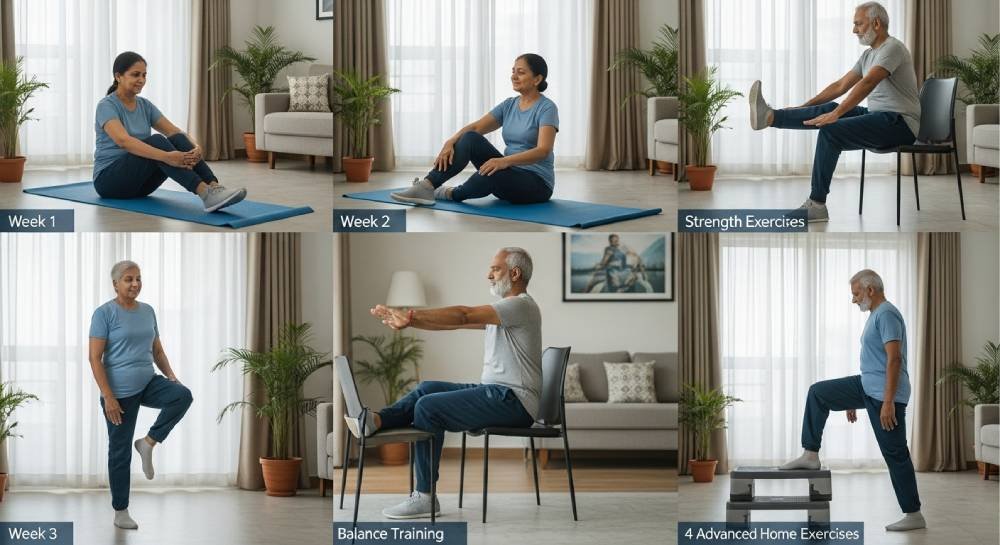
The 4-Week Home Physiotherapy Plan for Knee Arthritis
⚠️ Note: Always begin under the guidance of a licensed physiotherapist — especially if you have severe pain or swelling. Once your movements are evaluated and cleared, you can safely continue these exercises at home.
Week 1: Gentle Mobility and Pain Reduction
Goal: Loosen stiff joints and improve blood flow without straining the knee.
Exercises:
- Heel Slides – Sit or lie down, slowly bend and straighten your knee 10–15 times.
- Quadriceps Sets – Tighten your thigh muscles (as if pushing the knee down into the floor) for 5 seconds; repeat 10–15 times.
- Ankle Pumps – Move your foot up and down to improve circulation and reduce swelling.
- Sitting Calf-Raises – Sit on a chair, put your feet flat on the floor, and raise only your heels up and down
- Ice Therapy (10–15 min/day) – Reduces inflammation if your knee feels warm or swollen.
💡 Tip: Focus on smooth, pain-free motion. Avoid deep bending or squatting in this phase.
Week 2: Building Basic Strength
Goal: Activate and strengthen key muscle groups that support the knee — particularly quadriceps, hamstrings, and hips.
Exercises:
- Straight Leg Raises – Lie down, tighten your thigh, and lift your leg slightly off the floor. Hold for 5 seconds. (10 reps x 2 sets)
- Mini Squats – Hold a chair, bend your knees slightly (not beyond 45°), and stand back up. (10 reps x 2 sets)
- Hamstring Curls – Stand and bend your knee backward toward your hip. (10 reps x 2 sets)
- Glute Bridges – Lie on your back, bend your knees, and lift your hips upward. (10 reps x 2 sets)
📊 Evidence note: Studies show that strengthening the quadriceps alone can reduce knee joint load by up to 25%, easing arthritis pain significantly.
Week 3: Improving Flexibility and Stability
Goal: Enhance mobility and joint stability to make daily movements easier.
Exercises:
- Seated Knee Extensions – Sit on a chair and straighten your leg slowly, hold for 5 seconds.
- Step-Ups – Use a low step or stair, step up and down slowly. (10 reps per leg)
- Standing Calf Raises – Strengthen calves and improve joint balance. (10–15 reps x 2 sets)
- Hamstring Stretch – Sit with one leg straight, reach toward your toes gently. Hold for 20 seconds.
💡 Pro tip: Avoid jerky movements or twisting the knee. Move with control and breathe through each exercise.
Week 4: Functional Strength and Endurance
Goal: Prepare your knees for daily activities like climbing stairs, walking, or light exercise.
Exercises:
- Wall Squats – With your back against a wall, lower slightly and hold for 10 seconds.
- Resistance Band Leg Press – Push against a band while lying down to build joint power.
- Side Leg Raises – Strengthen glutes and outer hip muscles for better knee alignment.
- Bridging with March – Lift your hips, then lift one foot off the floor at a time.
As strength and confidence grow, your physiotherapist may gradually add low-impact aerobic exercises like brisk walking, cycling, or swimming to your weekly plan.
Lifestyle & Postural Tips for Knee Arthritis Relief
Physiotherapy works best when supported by daily lifestyle changes:
- Maintain a healthy body weight to reduce joint load.
- Avoid deep squats, kneeling, or sudden twists.
- Use supportive footwear to cushion joint stress.
- Keep your core and hips strong — they control knee alignment.
- Practice heat therapy before exercise and cold packs afterward to manage stiffness.
When to See a Physiotherapist
If your pain persists beyond a few weeks or you notice swelling, locking, or grinding in your knee — it’s time to consult a physiotherapist.
Professional guidance ensures your exercises are tailored to your condition, preventing further wear and tear.
At Jaya Physio Clinics, Hyderabad’s trusted centre for joint rehabilitation, our team designs personalized physiotherapy plans for knee arthritis based on each patient’s mobility, pain level, and lifestyle.
We combine manual therapy, exercise rehab, and postural correction to restore movement naturally — without depending on injections or surgery.
Final Thoughts
Knee arthritis doesn’t have to mean giving up your favorite activities.
With the right physiotherapy plan and consistency, you can strengthen your knees, reduce pain, and reclaim your mobility — all from the comfort of your home.
Start small, stay consistent, and listen to your body — your knees will thank you for it.
📍 Visit us: Jaya Physio Clinics, 3rd Floor, Plot 266, Beside D-Mart, Kavuri Hills, Madhapur, Hyderabad
📞 Book a physiotherapy consultation: +91-99635 37999
🌐 jayaphysioclinics.in
