
Whether you’re a runner preparing for your next marathon, a cricketer playing weekend leagues, or a fitness enthusiast training daily — sports injuries can feel devastating. The moment pain hits, everything pauses: training stops, confidence dips, and performance goals slip out of reach.
But here’s the good news — with the right sports injury rehabilitation process, you can recover safely, regain strength, and return to sport stronger than before. The key is following a structured, step-by-step physiotherapy protocol rather than relying on random rest or self-treatment.
This guide breaks down the complete sports injury rehabilitation process, from the moment injury occurs to full return-to-play.
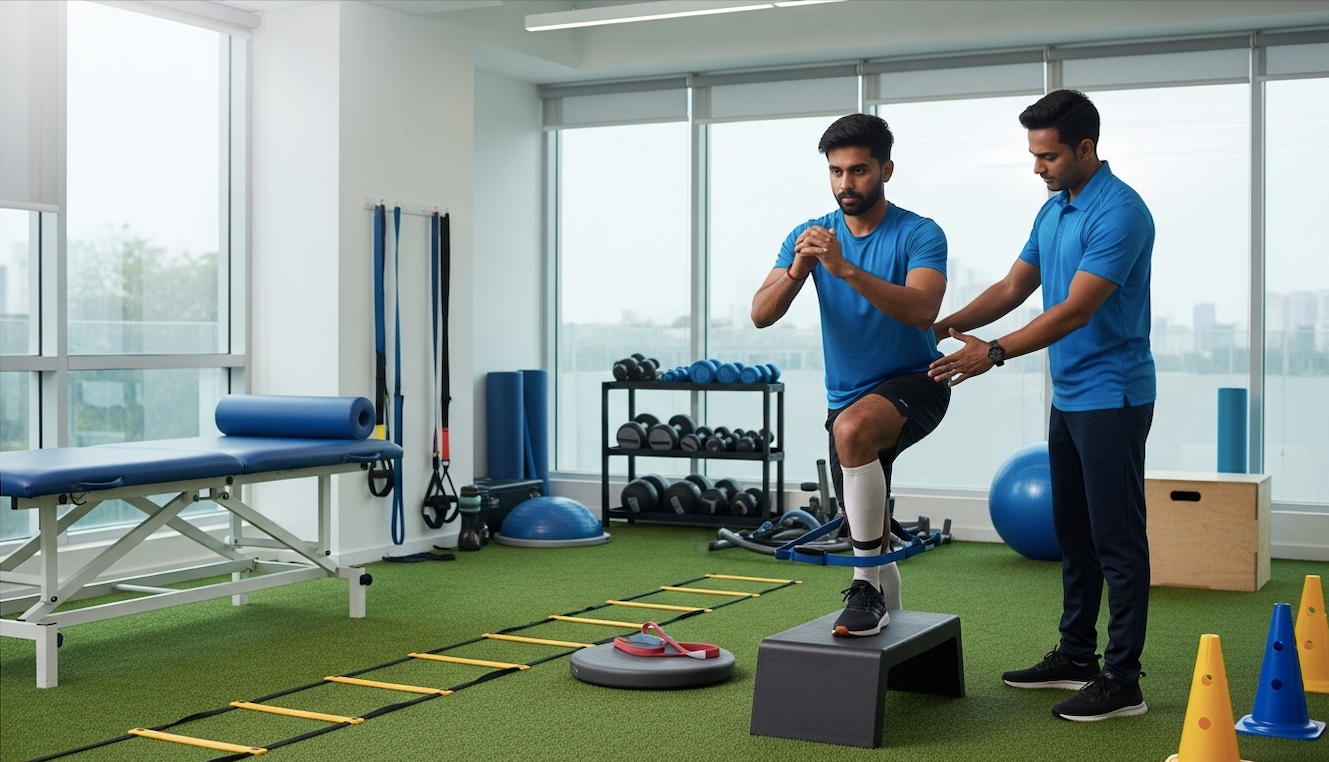
Step 1: Immediate Care and Pain Reduction
The first stage begins within minutes to hours after the injury.
Common scenarios: sprained ankle, muscle pull, ligament strain, shoulder injury, or sudden knee pain.
Goals of This Phase:
- Reduce pain & swelling
- Protect injured tissues
- Prevent further damage
Treatment Includes:
- R.I.C.E protocol (Rest, Ice, Compression, Elevation)
- Electrotherapy such as IFT or TENS for pain relief
- Support bracing or taping if required
- Basic mobility within pain-free range to prevent stiffness
This is a short but crucial phase — improper early care often leads to delayed recovery or recurring injuries.
Step 2: Assessment and Diagnosis by a Sports Physiotherapist
Before beginning treatment, a detailed assessment is essential.
A sports physiotherapist evaluates:
- Range of motion
- Strength deficits
- Balance and stability
- Pain characteristics
- Movement patterns
- Biomechanics
This helps identify not just where the pain is, but why the injury happened.
For example:
A runner with knee pain might actually have weak hip stabilizers.
A cricketer with shoulder pain may have poor rotator cuff activation.
Accurate diagnosis shapes the entire rehab plan.
Step 3: Restoring Range of Motion and Early Mobility
Once inflammation reduces, physiotherapy shifts toward gentle mobilization.
Goals:
- Restore normal movement
- Reduce joint stiffness
- Prevent compensatory movement habits
Common Techniques:
- Assisted stretching
- Joint mobilization
- Soft tissue release
- Gentle active exercises
This stage helps the body regain fluid, pain-free movement — essential for later strength training.
Step 4: Strength Training and Muscle Activation
This is the core phase of rehabilitation — often the one that determines long-term success.
Goals:
- Strengthen injured and supporting muscles
- Correct imbalances
- Improve joint stability
Exercises May Include:
- Band-resisted movements
- Closed-chain exercises like squats, step-ups, bridges
- Core strengthening
- Glute activation drills
- Proximal (hip/shoulder) stability work
Research shows strengthening surrounding muscles reduces reinjury risk by up to 50% in field sport athletes.
Without this phase, pain may reduce temporarily, but performance will not return — and recurrence is likely.
Step 5: Proprioception, Balance & Neuromuscular Control
Many athletes skip this phase — and it’s the reason injuries return.
When you get injured, your neuromuscular system loses its reflexive stability. This affects agility, landing mechanics, and quick directional changes.
Training Includes:
- Single-leg balance
- BOSU ball drills
- Reaction-time exercises
- Agility ladder work
- Coordination-based circuits
These exercises retrain your body to respond instantly during sports — preventing future injuries.
Step 6: Functional and Sport-Specific Training
Now that strength and control are restored, physiotherapists introduce sport-specific drills such as:
- Sprint mechanics
- Cutting and pivoting drills for footballers
- Bowling/throwing mechanics for cricketers
- Jump training for basketball or volleyball
- Stroke-specific drills for racket sports
These movements simulate actual game conditions, preparing the athlete both physically and mentally.
At Jaya Physio Clinics, athletes transition into Trans-Form PRO, our performance-enhancement system that bridges rehab and high-level athletic conditioning.
Step 7: Return-to-Sport Testing and Performance Reintegration
Before clearing an athlete for return to competition, physiotherapists conduct objective tests like:
- Hop tests
- Strength comparison between both sides
- Dynamic balance tests
- Fatigue-resistance assessments
- Functional movement screening
Only when these metrics show readiness does the athlete return to full sport.
This prevents premature return — the biggest reason athletes get re-injured.
Step 8: Maintenance, Recovery & Injury Prevention Plan
Rehab doesn’t end when pain disappears.
Athletes receive a maintenance plan including:
- Mobility routines
- Strength training cycles
- Warm-up strategies
- Recovery protocols (ice, stretching, physiotherapy check-ins)
This keeps the body resilient and performance-ready.
Why Sports Physiotherapy Matters in Hyderabad
With increasing participation in marathons, turf sports, fitness competitions, and school athletics, Hyderabad is seeing a sharp rise in overuse injuries, ligament tears, and muscle strains.
- Faster recovery
- Safe return to play
- Lower reinjury risk
- Improved technique and performance
Jaya Physio Clinics: Hyderabad’s Trusted Sports Rehabilitation Centre
At Jaya Physio Clinics, our sports physiotherapists and strength-conditioning experts provide a root-cause based, structured rehab system integrating:
- Manual therapy
- Mobility restoration
- Progressive strength training
- Biomechanical correction
- Sport-specific conditioning
- Chiropractic alignment (when required)
We help athletes return not just pain-free — but better, stronger, and more confident.
Final Thoughts
Every sports injury has a recovery path — but only a structured, scientific rehab process ensures complete and safe healing. Whether you’re dealing with an ankle sprain, ACL tear, shoulder injury, tendonitis, or chronic pain, physiotherapy guides you through every phase of recovery.
Your comeback starts with the right rehab plan.
📍 Visit us: Jaya Physio Clinics, Madhapur, Hyderabad
📞 Book a Sports Rehab Session: +91-99635 37999
🌐 jayaphysioclinics.in
