
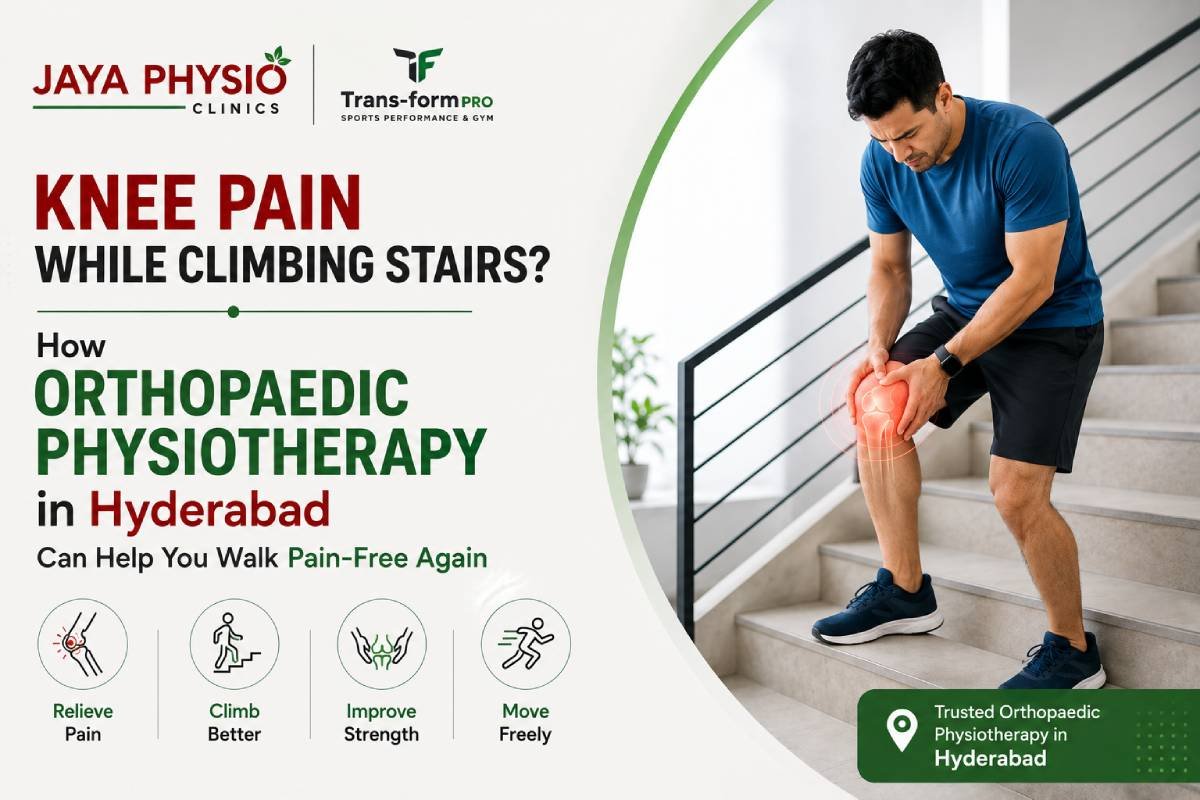
That sharp twinge in your knee every time you climb the stairs is easy to ignore – until it isn’t. Many people dismiss it as “just age” or “normal wear and tear,” but stair-climbing pain is one of the earliest and clearest warning signs your knee can give you. The good news? For most people, it is very treatable. Orthopaedic physiotherapy in Hyderabad has helped thousands of patients go from avoiding staircases to walking, climbing, and even running pain-free – without surgery, and often without long-term medication.
Why Do Knees Hurt More on Stairs?
Here’s a fact that explains a lot: when you climb stairs, the force passing through your knee joint is roughly three to four times your body weight. Walking on flat ground loads the knee far less. That’s why stairs expose problems that everyday walking hides.
The most common culprits behind stair-related knee pain include:
- Patellofemoral pain – the kneecap not tracking smoothly over the thigh bone, usually due to muscle imbalance
- Early osteoarthritis – gradual wearing of joint cartilage, common after 40
- Weak quadriceps and glutes – when these muscles can’t absorb load, the joint takes the hit
- Old injuries – a ligament or meniscus issue from years ago that was never fully rehabilitated
- Tight hip and ankle joints – forcing the knee to compensate for movement it shouldn’t have to do
Notice a pattern? In most of these cases, the knee is the victim, not the villain. The real problem often sits in the muscles and joints around it.
The Root Cause Approach: Why It Matters for Knee Pain
Most clinics ask, “Where does it hurt?” At Jaya Physio Clinics, the question is, “Why does it hurt?” This is the foundation of good orthopaedic physiotherapy in Hyderabad or anywhere else – because treating only the painful spot is like repainting a wall while the pipe behind it keeps leaking.
A proper orthopaedic assessment examines:
- How your kneecap moves and tracks
- Strength of your quadriceps, hamstrings, and hip muscles
- Mobility of your hip and ankle joints
- Your walking and stair-climbing pattern
- Alignment issues such as flat feet or knock knees
Only after identifying the actual cause does a meaningful treatment plan begin.
What Treatment Looks Like
Evidence-based orthopaedic physiotherapy for knee pain typically progresses through four stages:
- Pain and Inflammation Control – Manual therapy, taping, and activity modification to calm the joint down so rehabilitation can begin comfortably.
- Restoring Mobility – Gentle joint mobilisation and stretching to recover full, smooth knee movement, along with releasing tight structures around the hip and ankle.
- Progressive Strengthening – The heart of recovery. Structured, gradually loaded exercises for the quadriceps, glutes, and calves rebuild the muscular support your knee has been missing. Research consistently shows strengthening is the single most effective long-term treatment for most knee pain.
- Functional Retraining – Practising the exact movements that hurt – stairs, squatting, sitting-to-standing – with corrected technique, so your knee learns to handle real life again.
Patients searching for orthopaedic physiotherapy in Hyderabad should look for exactly this kind of staged, individualised plan rather than a one-size-fits-all machine-based routine.
Can Physiotherapy Help Even If I Have Arthritis?
Yes – and this surprises many patients. Multiple large studies show that structured exercise therapy reduces arthritic knee pain and improves function, often delaying or entirely avoiding the need for knee replacement. Cartilage wear on a scan does not automatically mean surgery; plenty of people with “worn” knees on X-ray live active, pain-free lives once the surrounding muscles are strong. This is why at Jaya Physio Clinics, scan reports are considered alongside – never instead of – a physical assessment.
When to Seek Help
Book an assessment if you notice:
- Knee pain on stairs persisting beyond two weeks
- Swelling after activity
- A feeling of the knee “giving way” or locking
- Difficulty squatting or kneeling
- Pain that is slowly making you avoid activity
The longer a knee problem is left, the more the muscles around it weaken – making recovery slower. Early orthopaedic physiotherapy in Hyderabad clinics like Jaya Physio typically means fewer sessions and faster results.
Walk Pain-Free Again
Knee pain on stairs is your body asking for help – not announcing retirement. With a root-cause diagnosis, hands-on treatment, and a progressive strengthening plan, most people return to pain-free stairs, walks, and workouts within weeks.
If stairs have become your daily struggle, visit Jaya Physio Clinics in Kavuri Hills, Madhapur – trusted for orthopaedic physiotherapy in Hyderabad since 2010 – and take the first step towards walking pain-free again.
