
An ACL (anterior cruciate ligament) tear can feel like a setback — especially for athletes or active individuals who thrive on movement. But the truth is, an ACL surgery is just the first step; what truly determines your success is how well you rehabilitate afterward.
Physiotherapy plays a central role in ACL recovery, guiding your knee through every stage — from regaining motion to restoring power and balance. And at the heart of that process lies strength training: rebuilding stability, control, and confidence in your knee.
If you’ve recently undergone ACL reconstruction or are preparing for it, here’s your phase-by-phase guide to progressive strength training after ACL surgery, curated by expert physiotherapists at Jaya Physio Clinics, Hyderabad.
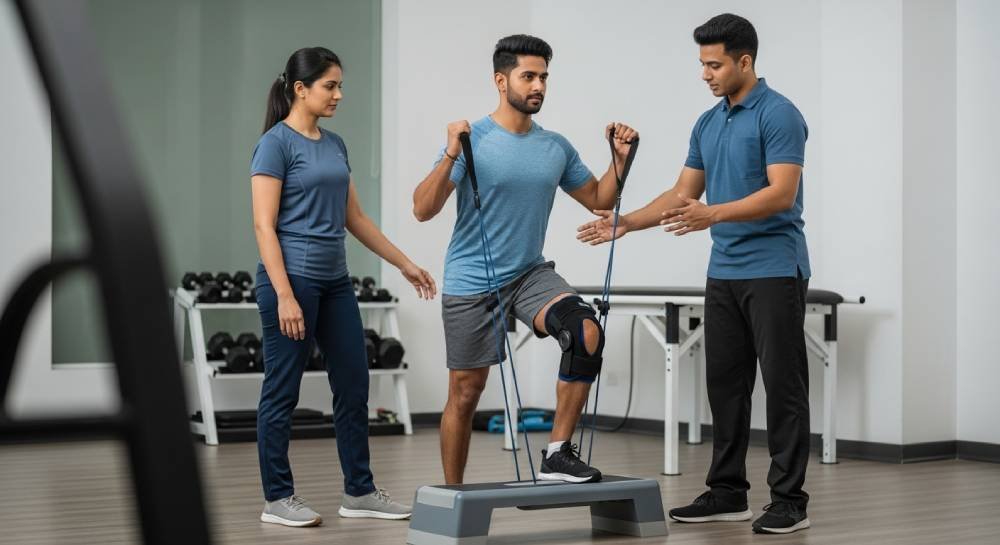
Understanding ACL Rehabilitation
The ACL is one of the key ligaments that stabilizes your knee joint. After surgery, the ligament graft needs time to integrate and strengthen — and your muscles, especially the quadriceps and hamstrings, must be retrained to support it.
Skipping or rushing this process can lead to graft strain, instability, or even re-injury, which is why structured physiotherapy and supervised strength training are non-negotiable.
📊 Fact check: Studies show that patients who follow a supervised physiotherapy protocol regain up to 90–95% of pre-injury strength within 6–9 months, while unsupervised recovery increases re-injury risk by 30–40%.
Phase-Wise Strength Training Plan After ACL Surgery
Phase 1: Early Recovery (Week 1–3)
Goal: Reduce pain & swelling, activate muscles, regain knee extension
In the first few weeks after surgery, the focus is on gentle activation — not heavy strength work.
Key exercises include:
- Quadriceps Sets: Tighten your thigh muscle by pressing the knee down into the bed. Hold 5 seconds, repeat 10–15 times.
- Ankle Pumps: Improve circulation and prevent stiffness.
- Heel Slides: Slowly bend and straighten the knee to restore mobility.
- Straight Leg Raises: Strengthen the quads without bending the knee.
🧠 Tip: Ice and elevation are crucial to control swelling. Avoid overloading the knee too early — your graft needs to heal first.
Phase 2: Controlled Strength Building (Week 3–6)
Goal: Rebuild muscle strength and restore movement control
Once your physiotherapist clears you, it’s time to progress into gentle resistance and balance training.
Exercises:
- Mini Squats (0–45°): Build quad and glute strength safely.
- Heel Raises: Strengthen calf muscles for stability.
- Terminal Knee Extension with Band: Use a resistance band behind the knee, push back to activate quads.
- Bridges: Strengthen hamstrings and glutes.
- Static Balance Exercises: Stand on one leg (with support initially).
💡 Note: Physiotherapists at Jaya Physio Clinics use electrical muscle stimulation (EMS) and manual therapy alongside exercises to accelerate muscle activation and reduce stiffness.
Phase 3: Advanced Strength and Stability (Week 6–12)
Goal: Restore functional strength and joint stability
Now that pain and swelling have subsided, the next step is to strengthen your knee dynamically — preparing it for normal walking and light sport-specific drills.
Exercises:
- Leg Press (0–90° range)
- Step-Ups and Step-Downs
- Hamstring Curls (with light resistance)
- Lunges (short stride)
- Core and Hip Strengthening: Bridges, planks, side-lying leg lifts
At this stage, your physiotherapist may introduce balance boards and proprioceptive training to retrain the knee’s stability sensors — essential to prevent future injuries.
📊 Research insight: A 2022 study in the American Journal of Sports Medicine found that neuromuscular and balance training post-ACL surgery reduces re-injury risk by 50% in athletes.
Phase 4: Functional Strength & Sport Reconditioning (Month 3–6)
Goal: Regain full muscle power, coordination, and dynamic control
Your exercises now mimic real-life or sport-specific movements. Physiotherapists monitor your gait, speed, and agility while gradually increasing resistance and impact.
Exercises include:
- Walking Lunges & Single-Leg Squats
- Resistance Band Side Walks
- Jump Training (Low Impact to Moderate)
- Agility Ladder Drills
- Cycling or Elliptical for Endurance
By the end of this phase, your knee should handle most day-to-day and low-impact sport activities without pain.
Phase 5: Return to Sport or Full Activity (Month 6–9+)
Goal: Regain explosive strength, speed, and confidence
This is where your physiotherapist and sports rehab specialist collaborate to ensure your knee is ready for high-intensity loading.
Exercises:
- Plyometric Jumps (with guidance)
- Sprint Drills & Change-of-Direction Training
- Sport-Specific Strength Conditioning
- Core & Dynamic Stability Circuits
Before returning to sports, you’ll undergo functional movement tests (like single-leg hop, Y-balance test) to ensure symmetry and readiness.
At Jaya Physio Clinics, this is often the stage where athletes transition into our Trans-Form PRO program — designed for post-rehab performance, injury prevention, and sport-specific strength.
Why Physiotherapy Supervision Is Essential
Every ACL surgery and recovery timeline is unique.
Without supervision, patients often:
- Overload the graft prematurely
- Neglect muscle imbalances
- Miss critical proprioception training
Physiotherapy ensures recovery is safe, scientific, and customized. At Jaya Physio Clinics, our ACL rehab specialists combine:
- Manual therapy for mobility
- Targeted strength training for the quadriceps, hamstrings, and hips
- Chiropractic alignment for joint balance
- Progressive load monitoring to avoid reinjury
Final Thoughts
Rehabilitation after ACL surgery isn’t a race — it’s a structured journey of rebuilding trust in your knee, step by step.
With expert physiotherapy guidance, strength training transforms from painful necessity into the key that unlocks your return to movement, confidence, and sport.
If you’re recovering from ACL surgery or planning one soon, remember: your comeback starts in physiotherapy.
📍 Visit us: Jaya Physio Clinics, 3rd Floor, Plot 266, Beside D-Mart, Kavuri Hills, Madhapur, Hyderabad
📞 Book your ACL rehab consultation: +91-99635 37999
🌐 jayaphysioclinics.in
